Asia/Kolkata
Projects

Building a GitOps Platform with Argo CD for Multi-Cluster Kubernetes

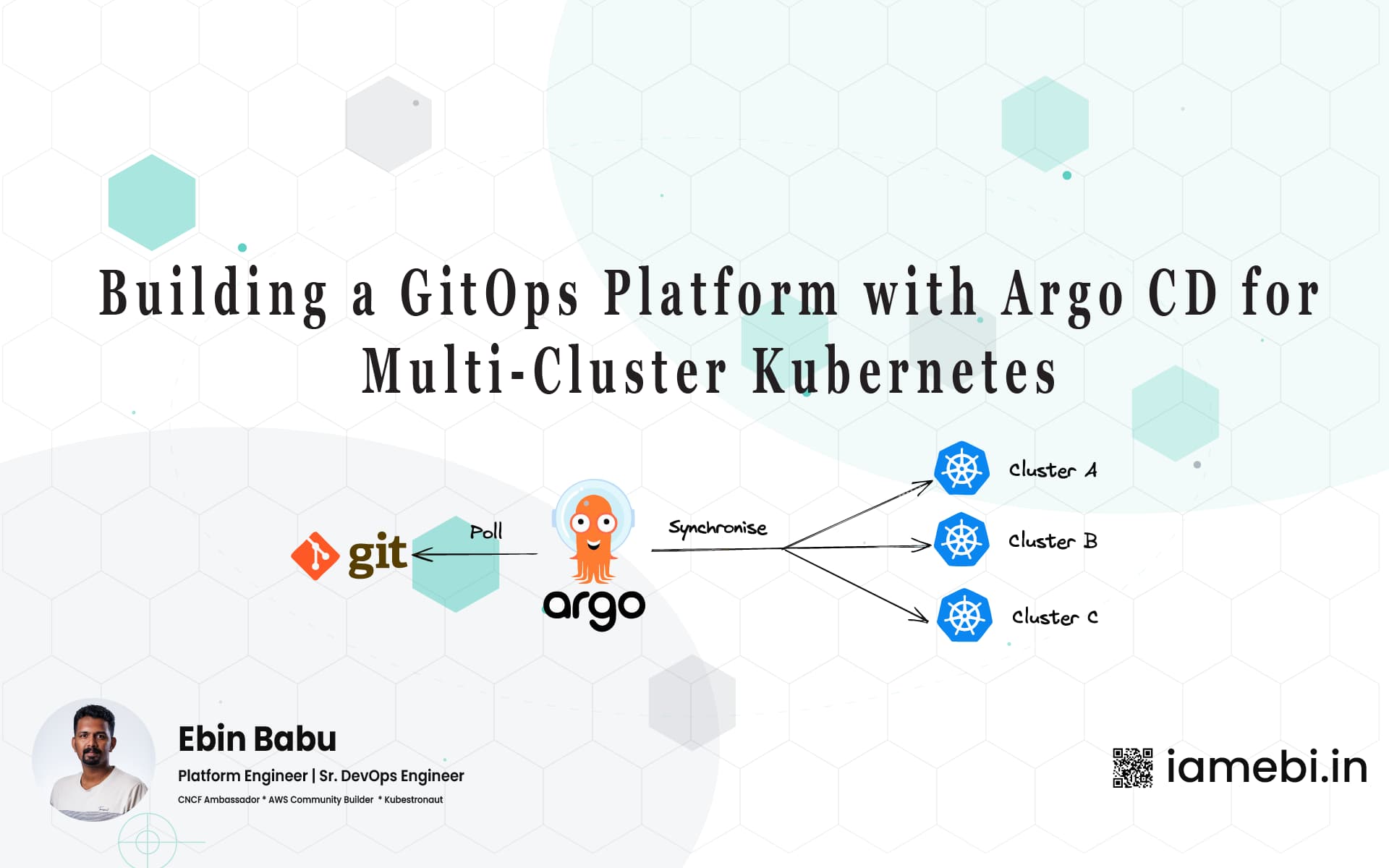
Designed and implemented a GitOps delivery platform using Argo CD across multiple Kubernetes clusters, reducing deployment errors by 80% and improving incident detection by 60%.
image
On this page
September 1, 2023
Modern platform teams need reliable, repeatable, and observable deployment workflows. As our Kubernetes environments expanded across development, staging, and production clusters, the existing deployment model began to show its limitations. To address this, we designed and implemented a GitOps-based continuous delivery platform using Argo CD, enabling automated, declarative deployments across multiple Kubernetes clusters. By making Git the single source of truth for infrastructure and application configuration, the platform introduced consistent deployment workflows, automatic drift detection, and significantly improved operational visibility.
Before adopting GitOps, deployments were handled through a mix of approaches:
  • manual kubectl apply commands
  • Helm releases triggered from CI pipelines
  • direct cluster modifications during troubleshooting
While these methods worked individually, they created operational complexity when combined. Several issues began to surface:
  • Inconsistent deployment workflows across teams
  • Configuration drift between environments
  • Limited visibility into the actual state of clusters
  • Difficult rollbacks during production incidents
  • Slow incident response due to uncertainty about deployed versions
With multiple teams contributing to Kubernetes deployments, maintaining reliability and consistency became increasingly difficult. The platform team needed a solution that would enforce declarative infrastructure management and consistent release processes across clusters.
The platform adopted the GitOps model, where all cluster state is declared and version-controlled in Git repositories. In this model:
  1. Desired cluster configuration is stored in Git.
  2. Argo CD continuously monitors the repository.
  3. The controller reconciles the Kubernetes cluster state with the declared configuration.
  4. Any configuration drift is automatically corrected or flagged for review.
This approach ensures that the Git repository always represents the desired state of the platform. Key benefits include:
  • reliable and repeatable deployments
  • improved traceability of changes
  • automatic drift detection
  • simplified rollbacks through Git history
To support multiple environments and applications, the Git repository was organized to leverage Helm charts with environment-specific values files. This structure provides a clean separation between application templates and environment configurations.
gitops-platform/
├── charts/                # Packaged application templates (Helm)
│   └── core-services/
├── values/                # Environment-specific configurations
│   ├── dev.yaml           # Development values
│   ├── staging.yaml       # Staging values
│   └── production.yaml    # Production values
└── clusters/              # Argo CD Root Application definitions
The charts/ directory contains reusable Helm charts that define the desired state of our applications. Environment-specific overrides are managed through Helm values files located in the values/ directory. This allows us to maintain a single chart while varying configurations like replica counts, resource limits, and ingress hosts across different clusters. By integrating Helm directly with Argo CD, the platform can automatically render manifests and detect drift based on the combination of the base chart and the specific environment's values file. This approach simplifies the management of complex deployments while ensuring that environment differences are transparent and version-controlled.
The platform manages four Kubernetes clusters through a centralized Argo CD control plane.
The management cluster hosts platform services such as:
  • Argo CD
  • monitoring stack
  • shared infrastructure components
This cluster acts as the GitOps control center for the entire platform.
The development cluster enables rapid iteration.
  • Automatic synchronization with Git
  • Deployments triggered on merges to the main branch
  • Fast feedback cycles for developers
The staging environment acts as the validation stage before production. Deployments are promoted through pull requests to the staging values file, ensuring controlled release progression.
Production deployments require an additional approval step. Manual synchronization is combined with Slack-based approval workflows, ensuring that critical changes undergo review before reaching live systems. This approach balances developer velocity with production stability.
Visibility into deployment activity is essential for maintaining operational reliability. Argo CD metrics are exported to Prometheus, while Grafana dashboards provide real-time insights into deployment health. Key metrics include:
  • synchronization success and failure rates
  • drift detection events
  • deployment frequency per team
  • lead time from commit to production
  • rollback frequency
These metrics help the platform team understand deployment reliability and release velocity, enabling continuous improvement of the delivery pipeline.
Handling secrets securely in a GitOps workflow requires a robust integration between external secret stores and the Kubernetes ecosystem. The platform leverages a cloud-native approach to secret orchestration. AWS Secrets Manager & External Secrets Operator (ESO) Instead of storing sensitive data in Git, the platform uses AWS Secrets Manager as the centralized vault. The External Secrets Operator (ESO) is deployed within the Kubernetes clusters to bridge the gap.
  1. Secrets are created and managed in AWS Secrets Manager.
  2. ExternalSecret resources are defined in Git and synced via Argo CD.
  3. The ESO controller fetches the sensitive data from AWS and dynamically creates native Kubernetes Secrets.
This ensures that no plain-text or encrypted secrets ever touch the Git repository, satisfying strict security and compliance requirements. Example External Secret configuration:
Yaml
apiVersion: external-secrets.io/v1beta1
kind: ExternalSecret
metadata:
  name: database-credentials
spec:
  refreshInterval: 1h
  secretStoreRef:
    name: aws-secrets-manager
    kind: ClusterSecretStore
  target:
    name: db-secret
  data:
    - secretKey: password
      remoteRef:
        key: prod/database/credentials
        property: password
This strategy provides secure, automated secret management that integrates seamlessly with our GitOps and Helm-based delivery pipeline.
Adopting GitOps with Argo CD significantly improved the reliability and efficiency of the deployment process. Key outcomes include:
  • ~80% reduction in deployment errors
  • ~60% faster incident detection through automated drift alerts
  • 100% audit trail for infrastructure and application changes via Git history
  • Deployment frequency increased from weekly releases to multiple deployments per day
  • Mean time to rollback reduced from 30+ minutes to under 5 minutes
Most importantly, teams gained confidence in the deployment process. Instead of manually pushing changes into clusters, they now rely on declarative configuration and automated reconciliation.
Implementing a GitOps platform using Argo CD and Kubernetes transformed the way deployments are managed across environments. By making Git the source of truth for cluster configuration, the platform introduced:
  • consistent deployment workflows
  • automated drift detection
  • faster recovery during incidents
  • improved visibility into system changes
For organizations operating multiple Kubernetes clusters, GitOps provides a powerful framework for managing infrastructure and application delivery at scale. As platform engineering practices continue to evolve, GitOps will remain a foundational approach for building reliable and scalable cloud-native systems.
Technologies: Argo CD · Kubernetes · Helm · External Secrets Operator · Prometheus · Grafana · GitHub Actions · AWS Secrets Manager · AWS EKS